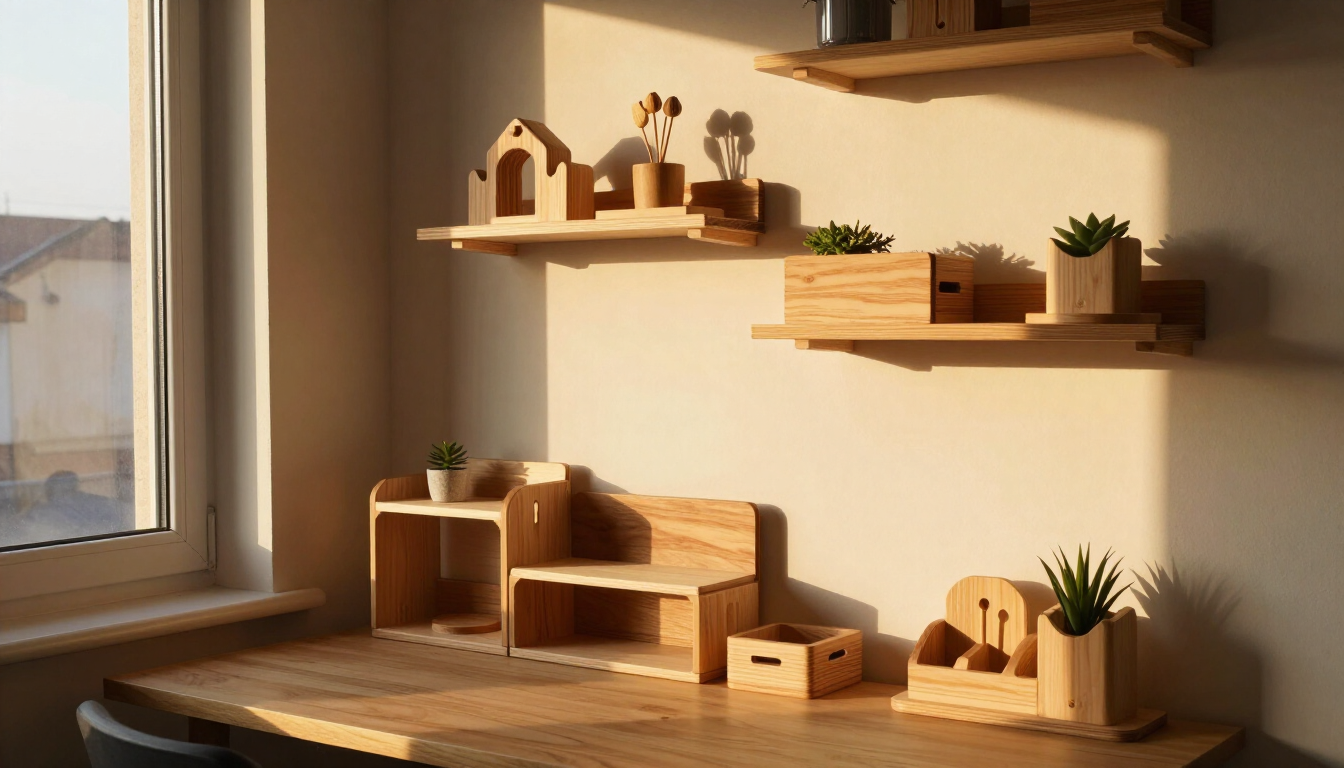
15 Best Woodworking Projects for Small Spaces
Do you love woodworking but don’t have a large workshop, garage, or dedicated workroom? You’re not alone. Many DIY enthusiasts work from a small corner of their home, a balcony, a compact garage, or a shared space that must serve several purposes — the same reality behind our guide to small woodworking shop ideas.
The good news is that you don’t need a huge workshop to enjoy woodworking. You can create useful, attractive projects with a modest collection of tools, careful planning, and a little creativity.
In fact, working in a small space can encourage you to become more organized. You learn to select projects carefully, minimize material waste by putting scrap wood to work, store tools efficiently, and make better use of every square meter.
The key is choosing projects that suit your available space, skill level, and equipment.
In this guide, you’ll discover 15 woodworking projects suitable for small homes and compact workshops, along with practical tips for organizing your work area and getting better results without filling your home with tools and lumber.
Why Small Woodworking Projects Make Sense
Small projects offer several advantages, particularly when you’re learning woodworking.
First, they usually require less material. You can practice measuring, cutting, joining, sanding, and finishing without committing to a large and expensive build.
Second, smaller items are easier to store and move. You may be able to complete a project on a portable workbench and store the finished piece in a cabinet until it’s ready for use.
Third, small projects are excellent for using leftover wood. Offcuts from larger boards can become phone stands, coasters, organizers, and decorative objects.
Finally, many small wooden products solve everyday problems. A well-designed desk organizer, wall shelf, or kitchen rack can improve a home while helping you develop valuable woodworking skills.
However, remember that a small project is not automatically easy. Accurate measurements, safe tool operation, and suitable joinery remain important regardless of the item’s size — our guide to common woodworking mistakes beginners should avoid covers the pitfalls that catch first-time builders.
1. Wooden Phone Stand
A wooden phone stand is an excellent first project because it uses relatively little material and can be customized in several ways.
A simple design may consist of a shaped base and a support slot that holds a phone at a comfortable viewing angle.
You can make a stand from a small piece of hardwood, plywood, or another suitable material.
How to approach the project
Begin by measuring the thickness and width of the devices you want the stand to accommodate.
Sketch the side profile and determine the viewing angle. Include enough support to prevent the phone from slipping.
If the stand includes a charging-cable opening, check that the opening is large enough for the cable connector.
Cut the parts carefully, sand the edges, and test the stand with the intended device before applying the finish.
Space-saving advantage: The finished product is small enough to store in a drawer or keep on a desk without taking up much room.
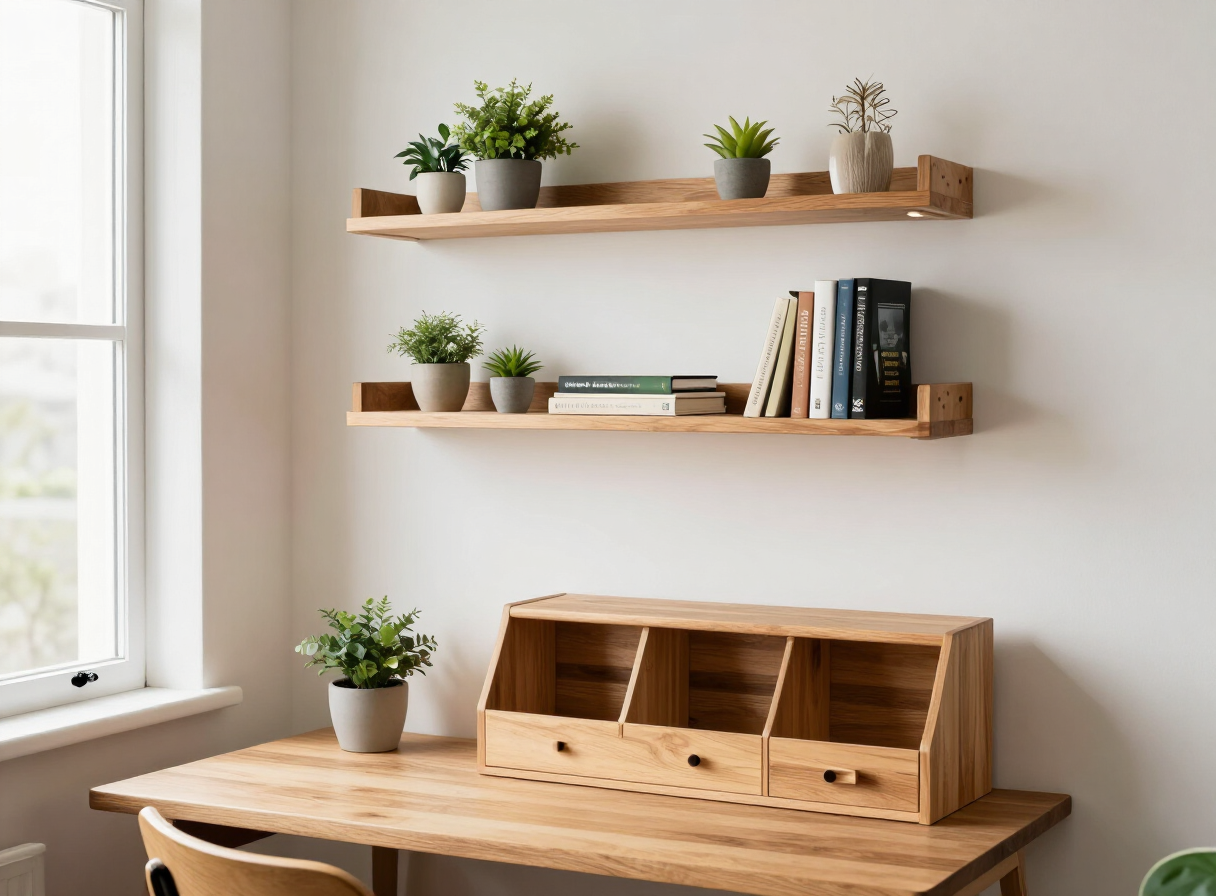
2. Floating Wall Shelves
Floating shelves are useful because they provide storage without occupying floor space.
They can hold lightweight decorations, small plants, framed photographs, or other items, provided the shelf and mounting system are suitable for the intended load.
A simple shelf may use a wooden board and concealed mounting hardware.
What to consider
Measure the wall area before choosing the shelf dimensions.
Check the wall construction and select mounting hardware designed for that material. The shelf’s load capacity depends on the board, bracket system, fasteners, wall structure, and installation quality.
Do not assume that an attractive shelf is safe simply because it feels sturdy in your hands.
For a beginner project, consider making a short shelf first. You can then experiment with different wood species, edge profiles, and finishes.
Space-saving advantage: You gain useful storage while keeping the floor clear.
3. Wooden Desk Organizer
A desk organizer can help keep pens, notebooks, charging cables, and small accessories in one place.
You can make a basic organizer from a wooden box divided into compartments or create a more elaborate design with a phone slot and removable trays.
Materials and construction
Start with a simple rectangular layout.
Measure the items you intend to store and allow enough space for them to be removed easily.
Cut the base and sides, then prepare the dividers. Depending on the design, you can use small butt joints, suitable fasteners, or another beginner-friendly joining method such as pocket hole joinery.
Dry-fit the parts before assembly.
Sand the inside corners carefully, since rough edges are more noticeable when the compartments are used every day.
Space-saving advantage: A single organizer can replace several small containers scattered across a desk.
4. Wall-Mounted Key Holder
Keys are easy to misplace, especially in busy households.
A wooden key holder provides a designated place for everyday keys and can be customized to match your home’s style.
A basic version consists of a wooden board and several suitable hooks.
More advanced versions may include a small shelf, a mail compartment, or a space for sunglasses.
Building tips
Choose a board with enough thickness to accept the intended hardware.
Mark the hook positions evenly and drill pilot holes where appropriate.
Select hooks designed for the intended load, and use a suitable mounting method for the wall.
If you want to personalize the holder, consider a decorative shape, contrasting wood, or a carefully engraved design.
Space-saving advantage: It uses a small amount of wall space to organize items that might otherwise occupy a table or countertop.
5. Wooden Coasters
Coasters are ideal for using small wood offcuts.
You can create square, rectangular, or round designs and experiment with contrasting wood tones.
A simple set can be made from carefully cut pieces that are sanded and finished consistently.
How to make the project more interesting
Instead of making a single coaster, create a matching set of four or six.
Use a simple holder to keep the set together.
Test the finish against moisture and follow the product manufacturer’s instructions for its intended use. Avoid assuming that any wood finish is suitable for repeated contact with wet drinking glasses. The Wood Database is a useful reference for understanding how different wood species react to moisture.
Space-saving advantage: Coasters require very little storage space and can be produced from leftover material.
6. Compact Wall-Mounted Tool Rack
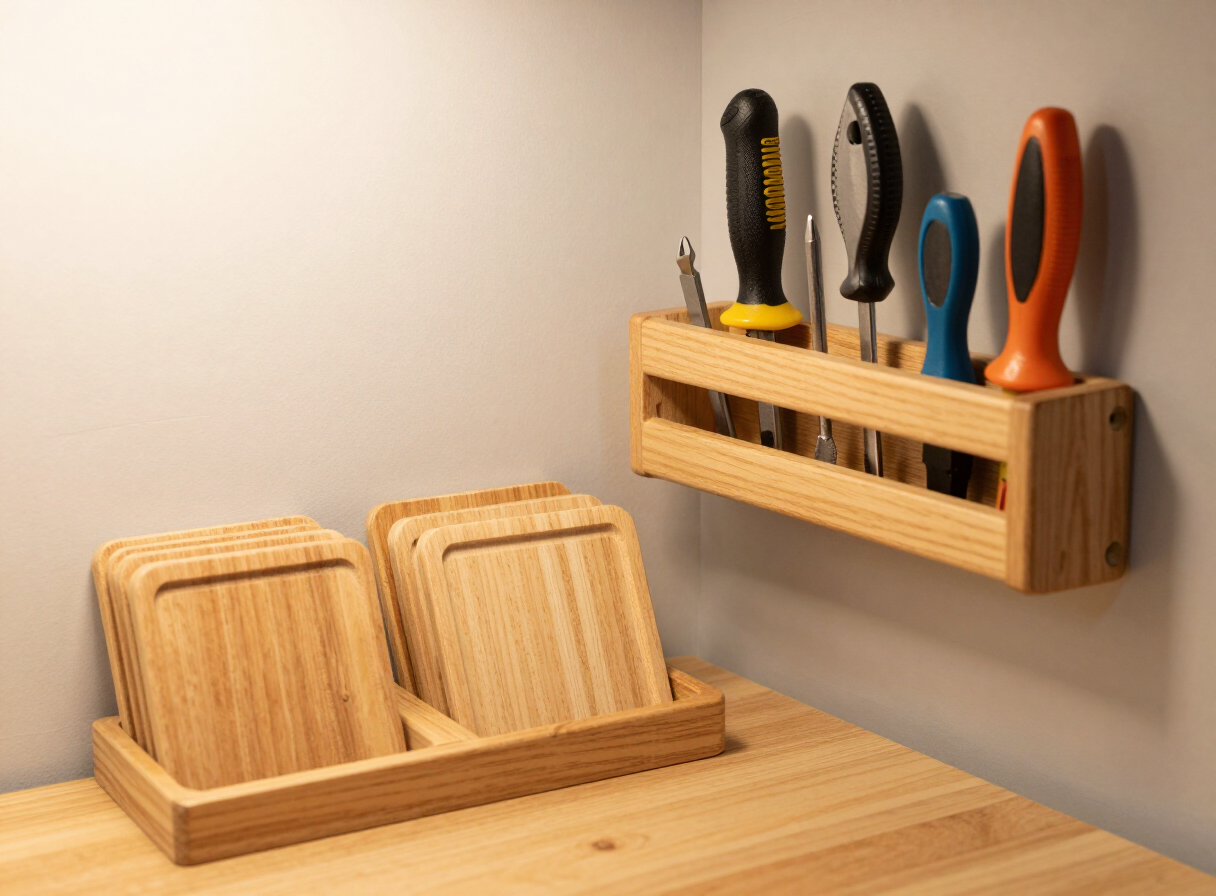
If your woodworking tools are spread across drawers, boxes, and shelves, a wall-mounted rack may help organize your workshop.
A simple rack can hold measuring tools, clamps, screwdrivers, and other equipment.
Before building it, list the tools you want to store and estimate their combined weight.
Design the rack with suitable supports and mounting hardware. Heavy tools should not be placed on a rack attached with inadequate fasteners.
Arrange the tools so that frequently used items are easy to reach without placing sharp edges in awkward positions.
Space-saving advantage: Wall storage frees up bench and floor space.
7. Wooden Laptop Stand
A wooden laptop stand can raise a laptop and provide a more organized desk arrangement.
Depending on the design, it may consist of a pair of supports, a platform, or an angled frame.
Measure the laptop and consider ventilation, stability, and the location of ports and cables.
The stand must support the intended device securely. Test it on a stable surface before regular use.
Avoid making unsupported claims that a particular stand will prevent pain or correct every ergonomic problem.
Space-saving advantage: A compact stand uses little desk space and may create room underneath for a keyboard or accessories.
8. Narrow Entryway Table
A narrow entryway table can provide a surface for keys, mail, and small decorative objects without occupying much floor space.
This project is more demanding than a phone stand or coaster because the structure must remain stable.
Begin with a simple rectangular design.
Choose dimensions that suit the available walkway and avoid making the table unnecessarily deep.
Use appropriate joinery for the legs, apron, and top. Check the completed table for rocking and instability.
If the table is tall or narrow, consider whether it requires suitable anchoring to prevent tipping.
Space-saving advantage: A shallow table provides useful storage in a narrow area.
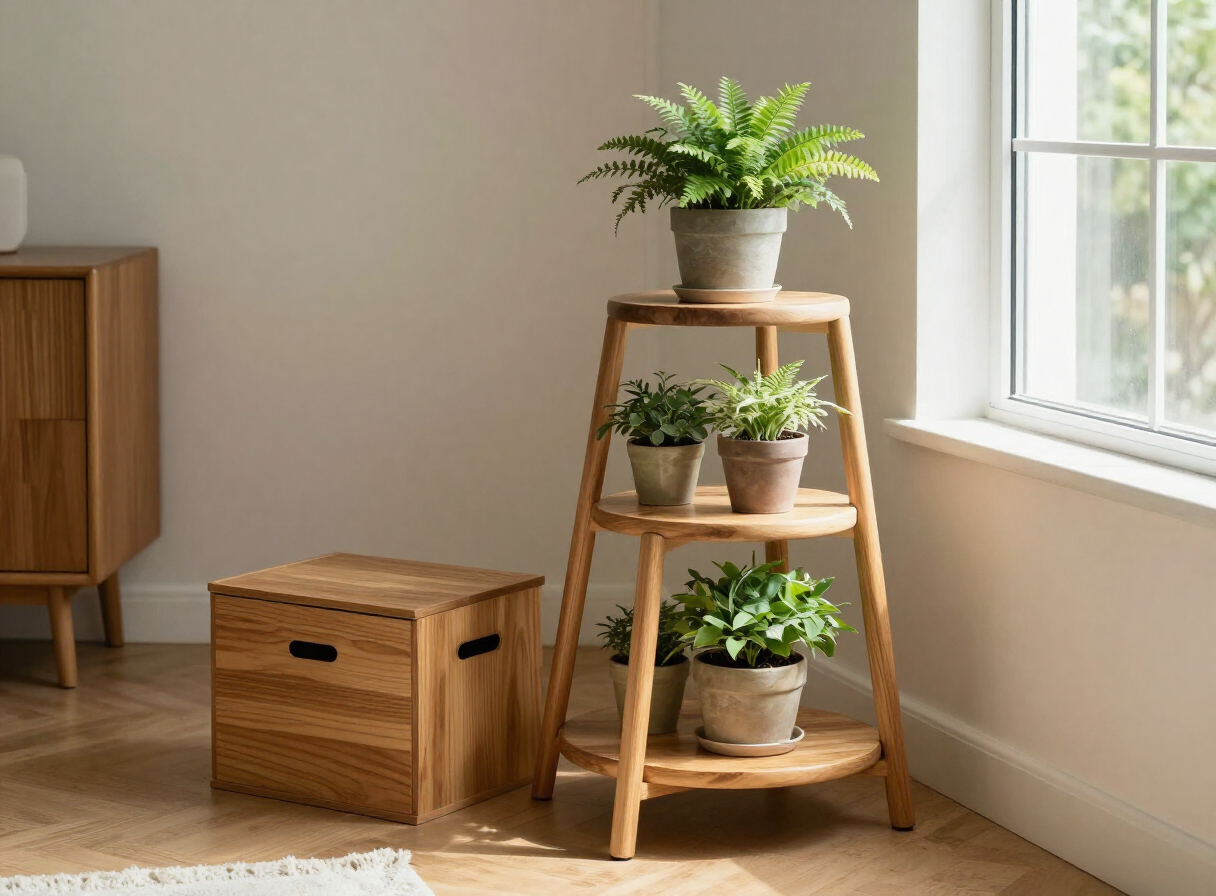
9. Wooden Plant Stand
A plant stand can bring greenery into a small home without using a large table or shelf.
A simple design may use a square top supported by four legs. More advanced versions can include multiple levels.
Important considerations
Measure the plant pot and allow enough room for easy removal.
Account for the weight of the pot, wet soil, and water.
Use a stable design with suitable joints. If the stand will be used near a window or outdoors, choose materials and finishes appropriate for the environment.
Provide a tray or another suitable method to protect the surface beneath the plant.
Space-saving advantage: Vertical plant stands can accommodate several small plants within a compact footprint.
10. Small Wooden Storage Box
Storage boxes are versatile projects that can hold craft supplies, tools, cables, stationery, or household accessories.
They are also useful for practicing accurate cuts and simple joinery.
Begin by deciding what the box will contain.
Measure the items and include enough clearance for easy access.
Cut the bottom and sides, assemble the box, and check that it sits flat.
A lid can be added later, once you’re comfortable with the basic construction.
If the box will carry heavy items, make sure the handles and joints are suitable for the load.
Space-saving advantage: Boxes help group small objects and can be stacked when their design permits it.
11. Folding Wooden Side Table
A folding side table can be useful in a small apartment or multipurpose room.
It can provide an occasional surface and be stored away when it isn’t needed.
However, folding furniture introduces moving joints and potential pinch points.
Use a proven design with suitable hinges or folding mechanisms. Check that the table locks or stabilizes as intended when opened.
Do not improvise the folding mechanism without understanding how it supports the load.
Test the table carefully before placing objects on it, and never use an unstable folding table as seating.
Space-saving advantage: The table can be folded and stored when the extra surface is unnecessary.
12. Wooden Headphone Stand
A headphone stand helps keep headphones off a desk and can complement a home office or gaming setup.
A simple design consists of a base and a curved or shaped support.
The base should be wide or heavy enough to prevent the stand from tipping.
Round over or smooth the contact surfaces to avoid damaging the headphones.
You can make the support from solid wood or build a simple assembly from smaller components.
Space-saving advantage: It keeps headphones in a consistent location without requiring a large storage box.
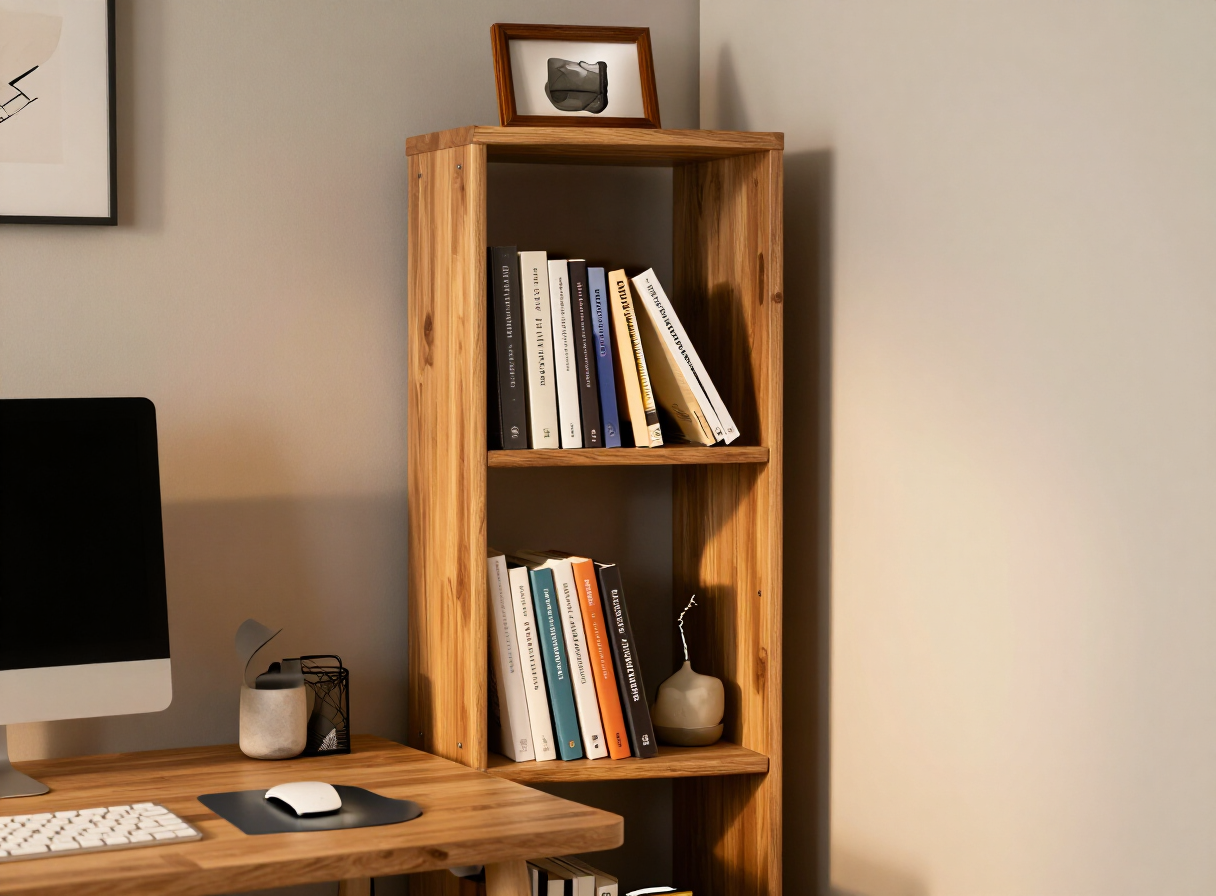
13. Compact Wooden Bookshelf
A small bookshelf can fit beside a desk, under a suitable counter, or in a narrow corner.
The main advantage of building your own is that you can customize the width, height, and depth — our complete guide to building a DIY bookshelf walks through the whole process.
Before cutting, measure the books and objects you intend to store.
Choose suitable material thickness and shelf spans for the expected load. Books can be heavy, so do not treat shelf design as purely decorative.
Assemble the unit squarely and use appropriate anti-tip hardware when necessary, particularly for taller designs.
Space-saving advantage: A custom-sized bookcase can use space that standard furniture might not fit.
14. Wooden Drawer Dividers
Drawer dividers are among the simplest ways to improve storage in a small home.
They can separate utensils, stationery, tools, or other small items.
Measure the inside dimensions of the drawer carefully. Remember that internal measurements may differ from the external dimensions.
Depending on the design, the dividers may be removable or fitted permanently.
Use smooth edges and avoid forcing the dividers into the drawer, since wood can expand with changes in moisture.
Space-saving advantage: Dividers make existing storage more efficient without adding another piece of furniture.
15. Wooden Cable Organizer
Charging cables can create clutter around desks, entertainment units, and bedside tables.
A small wooden cable organizer can provide slots or openings that guide cables into predictable positions.
Plan the opening sizes around the cables and connectors you use.
Sand the openings carefully to prevent sharp edges from damaging cable insulation.
Keep electrical connections accessible, avoid trapping heat around powered devices, and never use a wooden organizer in a way that creates an electrical safety hazard.
Space-saving advantage: It organizes existing cables rather than requiring additional storage furniture.
How to Set Up a Small Woodworking Area
Choosing compact projects is only half the solution. Your workspace also needs to support safe and efficient work.
Start With a Portable Workbench
A portable workbench or sturdy folding work surface can be useful when you cannot dedicate an entire room to woodworking.
The surface must be stable and suitable for the forces generated by your tools.
Use clamps or an appropriate work-holding system to secure the material.
Never make cuts on an unstable table or hold a workpiece in your hand while operating a tool that requires secure support.
Choose Tools Based on Your Projects
Do not buy tools simply because a woodworking video uses them.
List the projects you want to build, then identify the tools required to complete those projects safely — our essential woodworking tools guide is a sensible starting point.
Basic measuring and marking tools are often more useful at the beginning than specialized machinery.
You can expand your tool collection as your skills and needs develop.
Store Tools Vertically
Wall racks, pegboards, and suitable cabinets can make use of vertical space.
Arrange tools so that heavy objects are securely supported and sharp edges are protected.
Keep frequently used tools accessible while storing hazardous items away from children.
Organize Lumber Carefully
Store boards where they will not create a tripping hazard.
Support lumber adequately to reduce unnecessary warping, and keep it away from damp floors.
Do not stack material in a way that can fall or block an exit.
Plan for Dust and Ventilation
Woodworking dust can be harmful when inhaled.
Use suitable dust extraction and respiratory protection based on the operation and material. Maintain good ventilation when applying finishes, adhesives, or other products that release vapors. The CDC/NIOSH woodworking safety guidance is a useful authoritative reference on the health risks and recommended controls.
Follow the product instructions and safety data for the materials you use.
Keep the Workspace Clear
A small workspace becomes difficult to use when offcuts, cords, tools, and unfinished projects accumulate.
Remove waste regularly, return tools to their storage locations, and keep walkways clear.
Good organization is not just about appearance. It can reduce distractions and help you notice hazards.
How to Choose the Best Project for Your Space
Before starting a new build, evaluate four factors.
Available room: Can you assemble and handle the project safely?
Tool requirements: Do you already have the necessary equipment, or can the material be cut safely by a supplier?
Storage: Where will you keep the tools, lumber, and finished project?
Skill level: Can you complete the project using techniques you understand?
Choose a project that fits all four factors instead of focusing only on the final appearance.
If you would rather follow a proven plan than design your own, a large plan library such as Ted’s Woodworking includes compact furniture, shelving, and storage plans among its 16,000+ step-by-step builds — giving you ready-made cut lists and diagrams for small-space projects that fit your home.
Affiliate disclosure: This is an affiliate link. If you purchase through it, we may earn a commission at no additional cost to you.
Frequently Asked Questions
Can I do woodworking in a small apartment?
You may be able to complete small projects if you have a suitable, stable workspace and can manage noise, dust, ventilation, and tool safety. Some operations may be better performed in a shared workshop or another appropriate location.
What are the easiest woodworking projects for small spaces?
Phone stands, coasters, desk organizers, small storage boxes, and drawer dividers are common beginner-friendly options — see our roundup of 15 easy beginner projects for more.
What tools do I need for small woodworking projects?
The required tools depend on the project. Measuring and marking tools, suitable cutting equipment, a drill, clamps, and sanding tools are common starting points.
Can I make money from small woodworking projects?
Yes, small wooden products can be sold, but profitability depends on customer demand, production time, materials, pricing, and selling costs — our guide to profitable woodworking projects you can make and sell is a practical starting point.
How can I reduce woodworking waste?
Prepare a cut list, plan cuts before cutting, reuse suitable offcuts, and choose designs that make efficient use of standard board sizes.
Final Thoughts
You don’t need a large workshop to enjoy woodworking.
By choosing compact projects, organizing tools carefully, and planning each build before cutting, you can make useful wooden products even when space is limited.
Start with a small project that solves a real problem in your home. Once you have completed it successfully, use the experience to improve your next build.
Small woodworking projects can help you develop skills, reduce material waste, and gradually create a workshop that works for your circumstances. When you’re ready for your next build, browse our woodworking plans guide or the full project library, and read our guide to starting woodworking at home on a budget for ways to keep your initial investment under control.